
How do these two variables coexist within your training?
Suppose you have done any reading on fitness forums or any other publication that reports on health and wellness. In that case, you have probably come to realize that the information is abundant and that you need to implement all of the changes at once. I see your viewpoint; as a former athlete, now coach, wanting to do everything possible to not just perform but feel your best in general is important. But where do we start and what should be prioritized?
Here is where I will begin…
Two important variables in training and programming as a coach are Intensity and Volume; let’s define these terms through the lens of training (as defined by the NSCA):
Intensity – a value for resistance exercise and indicates the quality of work performed; the effort expended during a training session.
Volume – the total amount of work done in a session (Load x Sets x Reps [volume load])
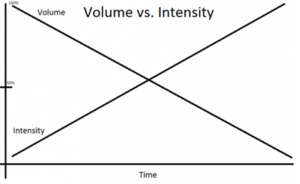
These two variables coexist in an inverse relationship. The higher the level of intensity of a movement, the fewer repetitions that can be completed safely without risking injury and/or overtraining; the lower the level of intensity of a movement, the more repetitions can be completed safely without risking injury and/or overtraining (image above; King Fitness, 2017).
“… volume digs a hole with a shovel and intensity digs with a spade” (Gill, 2023).”
I have coached 1-1 clients, group classes, general population along with elite-level athletes and one key element I discuss with every single group is this relationship between these two variables. Lets visit the other two corners (low intensity/low reps; high intensity/high reps) of this diagram to better understand why this relationship is important:

Low Load/Low Repetitions – the amount of volume one would accumulate would not be enough to see results over the short and long term. However, this relationship between the two variables is a great way to work out after a few weeks of hard training. This will allow us to stay consistent, and continue to work on movement patterns while letting our bodies recover for our next bout of harder training.
High Load/High Repetitions – this is the ultimate danger zone! It will be easier for us to reach failure, however at the cost of serious injury. This form of the relationship will most likely lead to injury before it leads to overtraining in my opinion, and if not then overtraining will lead to injury. Our bodies can only withstand so much work capacity/output in a single repetition and session as well as over multiple sessions in a given time frame. The adage “No pain, no gain,” couldn’t be farther from the truth and to be completely blunt, absolutely idiotic and stupid!
Now that I have provided some context on this subject, what is the short of the long…?
What do we do with this information moving forward and how do we improve our training through changing these two variables, intensity and volume?
First…..know what you are training for. Building muscle? Maximum power, strength and speed? To keep up with my kids as they become more active?
Knowing your WHY will determine your training methodology; this doesn’t mean that we have to exclude anything unless you simply want to. A variation of training methods from bodybuilding to muscular endurance to CrossFit to long-distance cardio will keep your training fresh and train your body to be ready for anything life throws at you (sometimes literally).
As someone who has dabbled in every one of these training modalities head-on, basically on their own, I have first-hand experience of how the body responds when you focus too much on one component of training. Utilize a balanced approach with intensity and volume in mind; I can almost promise you will be in the best shape of your life and feel so good about what you are doing and that you are doing it. Just remember this:
Easy weight…..can move for lots of reps and/or an extended period of time. Heavier weight…..fewer reps for shorter periods of time; that’s all we really need to know.
Thank you for reading and I hope you can take something away from this article.
Now go move some f*cking weight!
– Coach Colin